
Xactimate Estimates: Why Your Scope Is Getting Cut Before an Adjuster Even Reads It
The Problem Starts at Line One
Most Xactimate estimate disputes don't begin at the negotiating table. They begin the moment a scope is submitted without the documentation structure that desk reviewers are trained to look for. Adjusters at large carriers run dozens of files a day. When your estimate arrives without embedded moisture readings, without photos anchored to specific line items, and without a clear narrative connecting the loss to the scope, it gets flagged for reduction before anyone picks up the phone. The cut isn't personal — it's procedural. And most restoration contractors hand them the scissors.
This article is about fixing that, specifically by changing how you build and document a scope before it leaves your desk.
What Adjusters Actually Flag — and Why
Carrier desk reviewers are not reading your scope to approve it. They are reading it to find anything that lacks evidentiary support. The most common triggers for a reduction or denial aren't inflated line items — they're missing ones. Specifically:
- Unsupported demo scope. If you're billing for full drywall removal on a wall cavity and your water damage logs show a moisture reading of 14% at the time of demo, expect a fight. The reading doesn't justify invasive demo. Either your logs weren't updated after the first 48 hours, or the equipment readings weren't captured at all.
- Detach-and-reset without a photo sequence. Cabinets, trim, and flooring that were removed and reinstalled need before, during, and after photos tied to the specific room and line item. A single "before" shot of a wet floor doesn't cover a $4,200 cabinet D&R line.
- Overhead and profit on a single-trade job. O&P is defensible on multi-trade general contractor coordination. On a one-trade mitigation-only job, carriers will cut it. If you're billing O&P, your scope needs to demonstrate multi-trade coordination explicitly — not assume the adjuster will infer it.
- Equipment charges without placement logs. An LGR dehumidifier billed for 5 days needs a daily placement log showing unit serial number, room, and readings. Without that, the carrier will approve 3 days at best.
None of these are new rules. They are the same standards that have existed for years. What changes is how consistently your documentation supports them — and that consistency is a workflow problem, not a knowledge problem.
How Water Damage Logs Connect to Line Item Survival
Water damage logs are the evidentiary spine of any mitigation scope. They are also the most commonly underbuilt document in a restoration file. A log that records only final readings is nearly useless for scope defense. What adjusters and umpires want to see is a drying curve: initial readings by material and location, daily readings at the same points, and a final confirmation that the material reached its dry standard.
When you build your Xactimate estimates, every line item tied to structural drying — wall cavity drying, subfloor drying, engineered hardwood removal — should map directly to a moisture reading in the log. Room 1, north wall, 24 inches above floor: if the log shows that reading at 19% on day one and 8.2% on day four, your scope for that wall cavity is defensible. If the log just says "wet" and "dry," the adjuster will apply their own judgment about what was necessary, and it will cost you.
The practical fix is simple but requires discipline: build your log template to match your Xactimate line item structure. If you're scoping by room and assembly, log by room and assembly. If your field technicians are logging by floor only, your scope and your documentation are speaking different languages, and the gap shows.
The Remote Xactimate Estimate Problem Nobody Talks About
Remote Xactimate estimate work — where an estimator scopes a loss from photos and field notes rather than a personal site visit — is increasingly common, particularly for carriers handling high-volume CAT events or for restoration companies that use third-party estimating services. The documentation burden on a remote estimate is higher, not lower, than an in-person scope.
Here's why: when an adjuster questions a line item on a remote estimate, there is no "I was there, I saw it" to fall back on. Every decision in the scope has to be traceable to a photo, a measurement, or a reading in the file. That means the field technician's photo set needs to be structured like a legal exhibit package — labeled by room, showing all four walls, ceiling, and floor, with close-ups of any anomaly that drives a line item. A 47-photo dump in a shared folder with filenames like "IMG_3847.jpg" is not a documentation package. It's a liability.
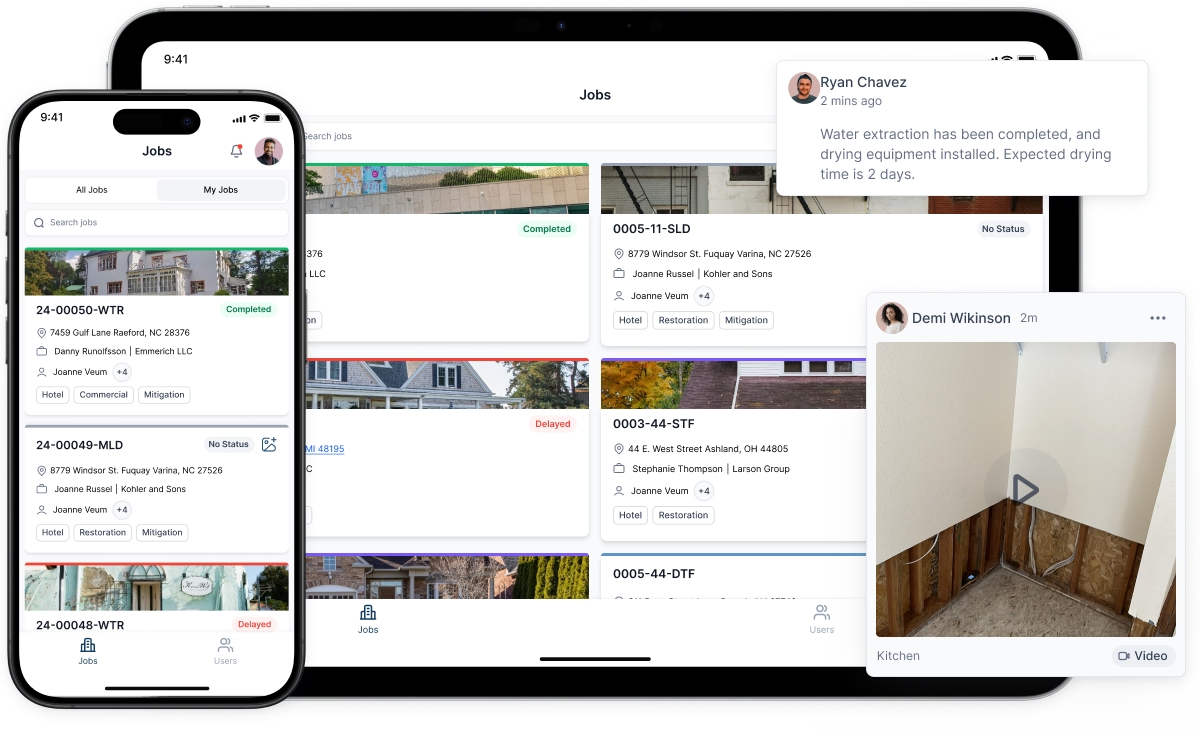
Restoration software that integrates photo management with the estimate file — where images are tagged to rooms and line items before the scope is written — closes this gap. When an adjuster asks why you scoped baseboard replacement in the hallway, you open the file and show them the photo of the baseboard at 22% moisture with the date stamp and the room label. The conversation ends there.
Where CRM for Restoration Companies Fits Into Scope Defense
A CRM for restoration companies does more for estimate accuracy than most contractors realize, because the estimate is rarely the only document in a file. It sits alongside the initial loss report, the signed authorization, the certificate of completion, subcontractor invoices, and the communication log with the property owner and carrier. When those documents are stored in disconnected systems — or worse, in email threads and paper folders — building a coherent file for a supplement or appraisal becomes a multi-hour reconstruction project.
When the CRM holds the full project record — every contact log, every signed document, every photo upload from the field — pulling together a supplement package takes minutes instead of half a day. More importantly, it creates a habit of documentation completeness. Technicians who know their field notes go directly into the project record tend to write better field notes. Estimators who can see the full communication history before writing a scope tend to catch gaps before the adjuster does.
The specific workflow that matters: your CRM should capture the initial carrier contact, the adjuster assignment, and any verbal or written scope agreements made before your estimate is submitted. If an adjuster told your project manager on day two that O&P was approved for this loss, and that conversation is in the CRM, you have a record. If it was a phone call that nobody logged, you have nothing.
Building a Restoration Scope That Holds
The difference between a scope that gets approved on first submission and one that goes three rounds of negotiation usually comes down to five things:
- Scope narrative that explains causation. Don't just list what you did. One paragraph at the top of the estimate explaining the loss mechanism — "supply line failure behind the kitchen cabinet, water tracked to the subfloor and adjacent wall cavities per moisture mapping" — gives the adjuster context for every line item that follows.
- Room-by-room moisture mapping attached to the estimate. Not as a separate email. Embedded in the file or submitted simultaneously with a clear reference in the scope.
- Photo references on high-value line items. For any line item over $500, cite the specific photo that supports it. "See photo set, Room 2, image 4 — north wall cavity exposed, reading 31%."
- Equipment logs with serial numbers and daily readings. This is non-negotiable for any equipment charge over two days.
- A supplement protocol, not a supplement reaction. If you know on day three that the loss is larger than the initial scope, document the change, get a signed change order from the property owner, and notify the adjuster in writing. Supplements that arrive after job completion with no prior communication are the hardest to get approved.
The Estimator Skill That Actually Separates Good Scopes from Great Ones
Xactimate proficiency — knowing the line item codes, understanding pricing databases, applying the right activity codes — is table stakes. Every competent estimator has it. What separates scopes that hold through desk review and appraisal is the estimator's ability to anticipate the specific objection an adjuster will raise and address it in the scope before it's raised.
That skill is built by reviewing denied or reduced line items systematically. Keep a log of every line item that gets cut on your estimates, the carrier, the reason given, and how you responded. After 20 or 30 projects, patterns emerge. Carrier A consistently cuts equipment charges beyond day three without a drying report. Carrier B never approves O&P without a general contractor license on file. Carrier C will approve full demo scope only if the moisture reading at demo time is documented in the log, not just noted in the estimate narrative.
That log is worth more than any Xactimate certification course, because it's specific to your market, your carriers, and your scope style. Build it. Review it before every estimate. Let it shape how you document the next job.
One Change Worth Making This Week
If your moisture log template and your Xactimate line item structure don't currently match each other, fix that first. Pull your last three estimates and your last three moisture logs side by side. For every demo or drying line item in the estimate, find the corresponding reading in the log. If you can't find it in under 30 seconds, neither can the adjuster — and they won't spend 31 seconds looking. They'll cut it.
Aligning those two documents is a half-day project that will recover more margin than any pricing negotiation you'll have this quarter.


